Monday, 24 August 2015

Bell-End, Manchester

Ojay, Nickindroy...

Essentially 2 culverted watercourses and a combined sewer overflow located in Droylsden.

This one had been on the to-do list a few years now.
Two small streams, which probably had their origins on Ashton Moss, originally flowed down two cloughs, Pinch Clough and Lumb Clough, joining together in Bell Clough, and thence into the Medlock.
These streams were culverted where they passed under the canal at the time it was built, after that point they reverted to nature, and both cloughs were in an uncultivated state.

A 2.2m brick egg outfalls onto the edge of Bell Clough


After a comedy attempt at accessing the outfall and narrowly avoiding a right soaking I decided we'd go in search of manholes instead.

Turned out to be a right bag of fail, as we beat about the bush looking for lids.


Eventually I spotted the first manhole submerged within another stream after Nick almost getting stuck in some bog.


One thing was certain this wasn't going to be our way in.

We piss-balled about for another hour looking for lids, ripped by brambles and stung by nettles we gave it up as light began to fade.

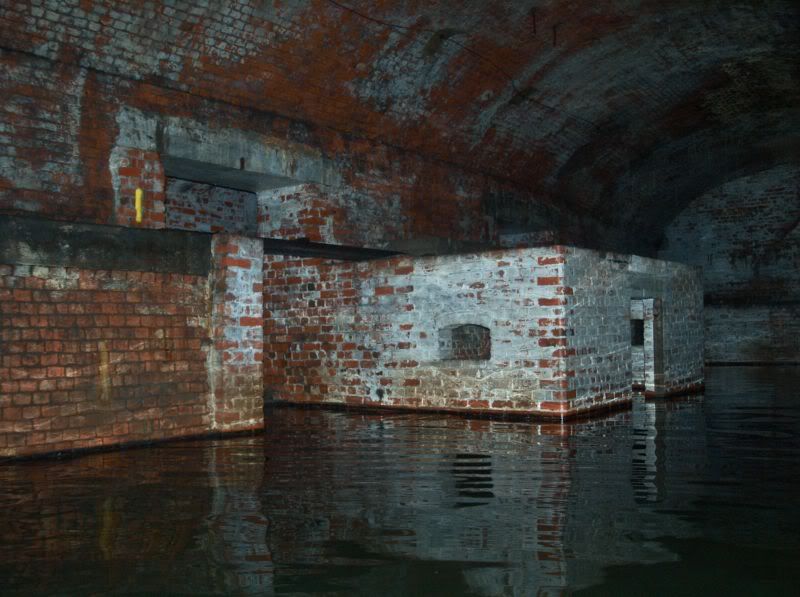
Our only option now was to head back to the outfall and traverse around the collapsing brick structure without ending up in the drink...

(It's pretty deep)


The surface water culvert heads upstream for around 50m through a distorted 2m egg as the earths pressure and boggy land above has taken it's toll over the years.


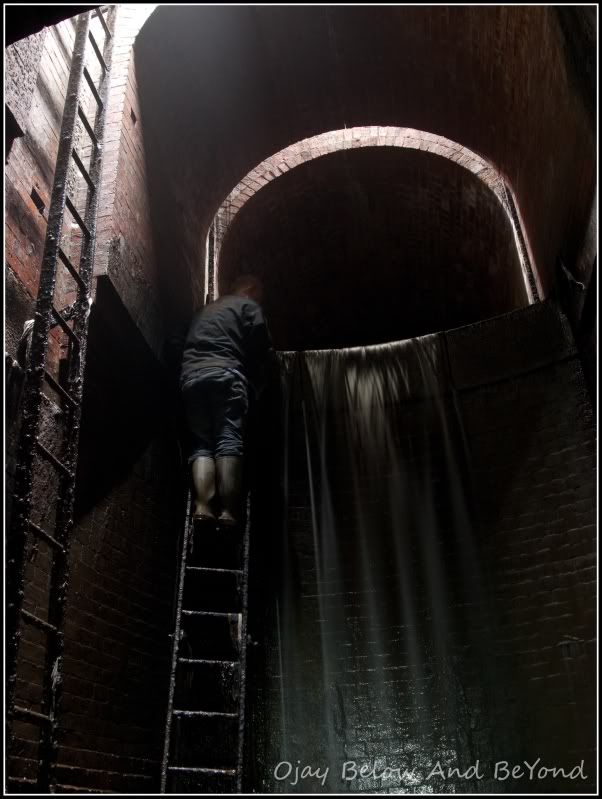
As shown  earlier ^^ the stream above ground cascades down the first manhole shaft, as the lid complete with frame has somehow managed to drop through and wash up around 100 yards downstream.

The frame is bigger than the aperture for the manhole, so we figured Murphy had lobbed it down before installing the biscuit thus avoiding cementing it in place, in favour of the boozer one Friday afternoon.


And a close up of the manhole taken by Nick


Beyond the shaft, brick quickly turns to concrete and the watercourse now runs through a 4.5ft RCP.


Those famous last words of "No more stooping" came back to haunt me as Nick pissed about grabbing a few shots..

We decided to plod on, muggins here went first with the meter and scraped the ceiling clear of spiders and cobwebs for the next 80m.

Thankfully another manhole presented itself, so at least I could stretch the old spine whilst waiting for Nick to play catch up.

The triangle shaped lid above was seized solid with probably 2 decades worth of rust, on the left a disused side pipe for what looked to be a surface water drain.

Having shone my torch up, it appeared to have collapsed around 5ft further in.


After spending a few minutes grabbing a couple of pics, we spent the next 10 mins debating whether to carry on.

The only thing keeping me motivated was the sound of water tumbling somewhere upstream, so I volunteered to head up and see if it was worth the effort.

60m of further stooping I arrived at a small junction.

On the left, a small watercourse drops in from above, stifled by familiar debris that often results in natural backfill at these ill-maintained infalls..

I shouted down to Nick to head on up as it was worth a couple of pics for our efforts.


We were now somewhere beneath Lumb Clough.

Ahead, the pipe shrunk to just under 4ft, the prospect of carrying on appeared grim but I was curious despite having an idea where this was heading.

The upstream section of RCP also serves as an overflow from a screened CSO that was installed circa 2008 a good 300m from this point.

I left Nick at the junction as it shrinks again, and again to way below 4ft.

100m later I declared bollocks to this!.. bent double, and pouring with sweat in a stinky shit pipe a tad over 3ft isn't my idea of fun on a school night.


Time to GTFO and head out for some cans.

Getting out was just as much a faff as Nick nearly had my eye out as he swung a scaff pole in order to aid our traverse across the lagoon of unknown depth beyond the outfall.

Hollinwood Gas Holder Site

Hollinwood Holder Station...

(The site in 1922)
The 165ft tall gasholder, which holds 144,000 cu ft of gas, was the largest in the country when it was built in 1913.
Consent was granted in November, 1992, for the storage of around 150 tonnes of natural gas but was since revoked.
National Grid finally agreed in 2013 they were to sell off the 215,000sq ft site for re-generation after having no further use for it since their previous review of the site in 2009.

Obviously subject to stringent planning, the land could one day be home to mixed residential/business use, a number of proposals have been put forward over the years.
I've run out of popcorn waiting to see what might materialize here..

It's not much in the way of a report, but I thought it was only right to document another industrial site that won't be around for much longer, albeit a few shonky pics taken on my phone so people can at least see what was once here in years to come.


Looking back at 'ya ;)


Re-visited in October with The Lone Ranger...


Friday, 31 July 2015

O Rly, London

Ojay/The Vicar...

The f0sheye had been kind to me in drains up until this point, it had taken a few knocks on the run up to this and in the end I wasn't happy with the results so went back with the 10mm and I'm still not happy with them either :p

This place had been a right pain in the arse to access, as come rain or shine there was always some unexpected flows over the last few years making access near on impossible for anything useful.


Casing point, this clip on a good day a couple of years ago now


^ There's one thing wrong with this, it's a storm relief sewer and should be bone dry, (except for during heavy downpours that is) go figure.

Confused.. I certainly was,  and bearing in mind that video clip was on a school nite, when it hadn't rained for at least a week either!


Lifting the lid was never pleasant, as on all but 2 visits some serious arse steam billowed out and turned an otherwise pleasant summers evening into some serious pea souper, the locals loved us.

It's not 'Deep Ochre' for nothing, the multi-laddered manhole shaft drops a good 60-70ft below the streets, at probably it's deepest point here where 2 storm relief's meet.

First discovered by JD & stoop, O Rly is a significant junction, where the North East Storm Relief (Deep Ochre) and the Holloway Storm Relief (Heavy Mettle) cross below North London.

It's also linked to the Northern High Level Sewer, which means you don't want to be down here when it rains!!

I was going to wait and post more of 'Deep Ochre' up as I'd done quite a bit more of the system, but never got around to finishing it off due to work, weather and other such factors.

So for now, these few shonky pics will have to suffice of the epic drain junction that is O Rly..


Here, looking upstream into the Holloway Storm Relief which runs 1.30km via a 7ft brick pipe from the O Rly junction which serves the Northern High Level Sewer.

It's my best guess a local trunk is being diverted somewhere between Holloway and the High Level, as we'd previously looked at the upstream connections and they appeared to have no flow.


Further down, the 5ft yellow brick shrinker eventually leads to the High Level Sewer, a huge CSO which we have since looked at which marks the start of the North East Storm Relief (Deep Ochre).


Turning around, here is the downstream view of the Holloway Storm Relief.

You can see the North East Storm Relief as it crosses below the metal work.


On the right, the first of 2 x 7ft stepped barrels which alleviate the Holloway Storm Relief and the Northern High Level Interceptor, allowing spill flows to pass through O Rly and continue down to the Thames via the North East Storm Relief.


Here is the Holloway Storm Relief (Heavy Mettle) looking downstream, the metalwork was once home to some oak dam board chase,  which has recently become dis-lodged and washed up into the top of the O Rly junction as seen in pic No.6 further below..


Again, on the right the second 7ft stepped barrel, it was slippery as hell, but had less flow and was much easier to clamber up.

You can see the oak dam board stuck in the overflow


O Rly


Here, flows exit the junction via a tumbling bay and further below an 8ft RBP which is a continuation of the North East Storm Relief (Deep Ochre) down to the Thames approx 2km away.


Shouts to GAJ/BHG/TheVicar/Adders/GE for persevering on this one amongst numerous aborted attempts.

Thursday, 2 July 2015

Grid-lock, Manchester

Ojay, Nickindroy...

Essentially A.N Other screened CSO located on the outskirts of Manchester, serving 3 small sewers and eventually outfalls into the Irwell.

The only clue something lies below is this surface building which houses the controls for the associated machinery below ground.


I'd almost forgotten about this one, until I drove past here the other week.

Myself and Nick took advantage of the recent sunshine and went for a closer look finally.

A fair bit of crawling on this one.

So Nick used his point & shoot for much of it, including the smaller sewers that feed into this system as I simply cba to get the dslr until we reached the screening chamber.

Manhole No.1 drops into barely a 2ft sewer as it heads in from a Northerly direction.

Excuse Nicks pic here, but the chamber was fairly confined and was impractical to be messing about with the dslr.


Ping pong balls ?

..Either way the sewer runs beneath this fetid head of arse foam and out the other side towards the screening chamber.

I was unfortunate enough to have my left leg and entire wellie engulfed in this festering pipe!

Keen to see the screening chamber we went in search of a suitable way in, sadly the lids are locked up.

We resorted to crawling up a 3ft pipe which is actually the overflow for the system.


Luckily it was dry, stooping is one thing, but crawling through shit pipes is no fun and I'd sworn I wouldn't do it again!

Still, every holes a goal..

A small inspection chamber was in sight, it allowed for some respite before continuing on.


Eventually we were inside the screening chamber.

It's only small and contains an archimedes screw which runs the length of it; used to filter the solids during peak flows.


Comprising a double sided weir, the screw is situated on the primary overflow.


I climbed over to the sewer for some pics and no sooner had Nick stepped up the machinery started turning.

Luckily for him it was just cycling through a self test which these things do periodically to keep them lubricated etc.

He may have scraped having his foot whipped off, but shortly after popped a rib trying to evade the sewer :D

The sewer runs through a 3ft channel between the 2 weirs, it's silted up with fatty deposits & rags which kicks up a right stench.

Here, the incoming line is around 3ft, but beyond soon shrinks back to 2ft as seen upstream at the start of this thread.


It exits through a much smaller aperture at the other side of the CSO.


It was sweltering down here, so we crawled back out into the fresh air.

Once out, I managed to locate a couple of lids which led to the downstream section of sewer.

The pics Nick took have come out a bit too dark, however there isn't much to see other than a 2ft streak of piss anyway.

Time to leave..